


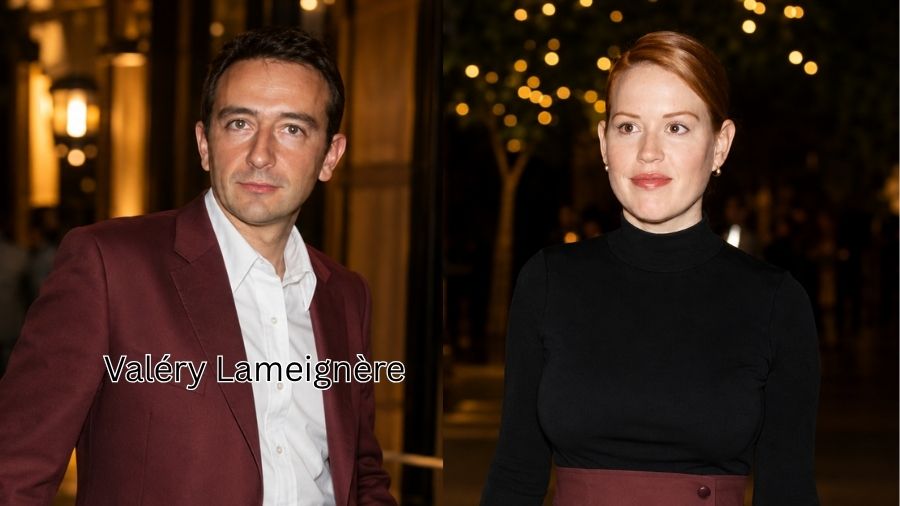
Most people arrive at the name Valéry Lameignère through a single line in a Hollywood biography: he was the Frenchman Molly Ringwald married in Bordeaux in the summer of 1999, and the marriage was over by 2002. That is the search that brings readers here, and it deserves a direct answer. Ringwald and Lameignère wed on 28 July 1999, divorced three years later, and had no children together. He was not an actor and never became a celebrity in his own right.
What tends to get lost is the rest of it. Under the same name, a French literary translator has spent more than two decades carrying English-language books into French, from mass-market thrillers to a bestselling romantic comedy and a musician’s memoir. That work is documented on book covers and publisher catalogues, and it is a far more substantial record than the three-year marriage that generates the search traffic.
Who Is Valéry Lameignère?
The reference record is short and consistent. Molly Ringwald’s first husband was a French writer named Valéry Lameignère. Encyclopedic sources and contemporaneous American press describe him that way, without a filmography, a discography, or any of the usual apparatus of fame. During the years he was married to Ringwald, he lived between Paris and New York while she moved between French cinema and Broadway.
Separately, the French publishing industry credits a Valéry Lameignère on the copyright pages of a long run of translated novels and non-fiction titles. Hachette maintains a contributor page under the name. So does the Livre de Poche catalogue, and so do independent bookshops across France that list him beside the authors he has translated. This is the professional identity that gives the name real substance, and it is the part of the story that competing profiles usually miss entirely, because they have copied one another rather than checking a publisher’s catalogue.
What the Record Actually Shows About His Early Years
Very little, and that is worth stating plainly rather than filling with atmosphere.
There is no reliable public source for his date or place of birth, his schooling, or his family. A number of websites confidently place his birth in 1968 and describe a childhood shaped by French literary culture. None of them cite anything. That figure appears to have originated on one site and been recycled across dozens more, several of which are automated content operations with no editorial oversight. It should not be treated as fact, and this article will not repeat it as one.
What can be said is that his professional life has been conducted in two languages, and that his surname has strong roots in the Bordeaux region of southwest France, the same city where his wedding took place. That is a geographical observation, not a biography.
A Career Built on Other Writers’ Words
The translation catalogue published under his name stretches from the early 2000s to the 2020s and moves across genres in a way that suggests a working professional rather than a specialist.
The commercial thriller and romantic suspense end came first. He is credited on L’œil du témoin, the French edition of Sharon Sala’s Butterfly, published in 2003. Heather Graham’s Deadly Harvest followed as Les proies de l’ombre, then Laura Caldwell’s Red Hot Lies as Le voile de la trahison, and Alex Kava’s Hotwire, the ninth Maggie O’Dell novel, as Effroi.
His most widely read work is almost certainly À moi la nuit, toi le jour, the French edition of Beth O’Leary’s The Flatshare. That novel became an international bestseller, has been translated into more than thirty languages, and the French edition has been reissued in paperback by Le Livre de Poche. Publisher listings for the book name him explicitly as the translator from English.
This is where the most common error about him originates. Goodreads files translators under author pages, so its listing for À moi la nuit, toi le jour describes him as the author of the book. He is not. Beth O’Leary wrote it. He wrote the French version of it, which is a different and considerable job.
Two later titles show the range. La Méthode Bullet Journal is the French edition of Ryder Carroll’s productivity bestseller, a book whose appeal depends entirely on precision of instruction. Suivie is Ellery Lloyd’s psychological thriller People Like Her. He also translated Tom Chatfield’s The Gomorrah Gambit as Bienvenue à Gomorrhe, an edition that carried the 2020 Prix Douglas Kennedy for best foreign thriller, and a French rendering of Elvis Costello’s memoir Unfaithful Music and Disappearing Ink.
Nine distinct works are catalogued under his name on Goodreads alone. The real total is likely higher, since translator credits are inconsistently indexed and commercial imprints often list them only inside the book.
The Bordeaux Wedding and a Marriage That Ended in 2002
Ringwald had left Los Angeles for Paris in the early 1990s after her post-John Hughes career stalled. She had been educated at the Lycée Français de Los Angeles and spoke the language fluently, and by the middle of the decade she was working in French productions. She and Lameignère met during those years.
They married in Bordeaux on 28 July 1999 and appeared together at a handful of New York events that autumn, including the premiere of Guinevere. The marriage lasted roughly three years. Ringwald filed for divorce and it was finalised in 2002. She married the American writer and editor Panio Gianopoulos in 2007, with whom she has three children.
Beyond those dates, the specifics circulating online are unreliable. Some sites give November 2002 as the finalisation date, others December, and several quote a legal filing phrase attributed to Ringwald. No court record or reputable contemporaneous report has been produced to support any of it. A divorce a quarter of a century ago between one public figure and one private citizen does not owe readers a narrative, and this profile will not manufacture one.
Why Readers Look Him Up
Search interest in Valéry Lameignère is almost entirely downstream of Molly Ringwald’s own visibility. Every wave of nostalgia for Sixteen Candles, The Breakfast Club, and Pretty in Pink, every new Ringwald role in Riverdale, Feud, or Monster, and every retrospective interview sends a fresh cohort of readers looking for the man she married in France.
There is a second, smaller stream: French readers who notice his name on a book they have just finished and want to know who translated it. Those two audiences want different things, and a page that answers only the first is doing half the job.
There is also a genuine curiosity in the symmetry. Ringwald herself later became a translator, bringing Philippe Besson’s Lie With Me and Vanessa Schneider’s My Cousin Maria Schneider from French into English. Two people whose lives briefly overlapped both ended up doing the same unglamorous, exacting work in opposite directions.
What Can and Cannot Be Confirmed
Two things in this profile deserve an explicit caveat.
First, the connection between the marriage and the translation catalogue rests on a matching name and a matching profession. Reference sources describe Ringwald’s first husband as a French writer; the French publishing industry credits a French literary translator with the same distinctive surname over the same period. No interview, publisher biography, or press report has been located in which the two are joined in a single sentence. It is a reasonable identification, widely made, and one that has not been confirmed by either party.
Second, the volume of material online about him is misleading. Searching his name returns a dozen near-identical profiles asserting a birth year, a net worth, an early passion for literature, and a personality. Almost none of it is sourced, and several of these pages are machine-generated on domains with no connection to entertainment reporting at all. Volume is not verification.
Conclusion
He is a working professional who happened to be married to a famous person for three years and has said nothing publicly about it since. Strip away the recycled guesswork and what remains is a clear, modest record: a wedding in Bordeaux in July 1999, a divorce in 2002, and a translation catalogue that has quietly delivered thrillers, bestsellers, and a rock memoir to French readers across two decades.
That is the honest version of Valéry Lameignère’s story. It is shorter than the invented one and considerably more interesting, because the work he has actually done outlasts the marriage that made his name searchable. Readers arriving here for Molly Ringwald’s ex-husband will find their answer in the first paragraph. What they may not expect is that the more durable part of the story sits on bookshelves in France, under a credit line most people never read.